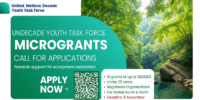
The UN Decade on Ecosystem Restoration (2021–2030) calls on the world to prevent, halt, and reverse the degradation of ecosystems across the planet. In support of this global mission, the UN Decade Youth Task Force (YTF) is inviting applications for the 2026 Ecosystem Restoration Microgrants, a funding opportunity designed to empower youth-led organizations driving environmental restoration and community resilience.
Key Dates
-
Applications Open: 1 December 2025
-
Deadline to Apply: 31 December 2025 (11:59 PM UTC)
-
Application Feedback: Mid-January 2026
-
Grant Period: February – July 2026
About the Microgrants
The 2026 microgrant cycle supports youth-led restoration initiatives across the following ecosystem categories:
Farmlands · Forests · Freshwater · Grasslands · Shrublands & Savannahs · Mountains · Oceans & Coasts · Peatlands · Urban Areas
A total of 10 microgrants of up to USD 1,000 each will be awarded. To promote equity and global representation:
-
80% of funds will support projects in the Global South
-
20% of funds will support projects in the Global North
These grants aim to strengthen youth leadership in ecosystem stewardship while promoting sustainable, community-driven impact.
Grant Objectives
Projects must align with the following SMART (Specific, Measurable, Achievable, Relevant, Time-bound) objectives:
1. Ecosystem Restoration
Restore or rehabilitate at least one eligible ecosystem category with clear and measurable ecological outcomes.
2. Youth & Community Engagement
Actively involve youth and local communities in restoration or conservation efforts.
3. Sustainable Land or Water Management
Implement at least one sustainable ecological practice based on recognized restoration and conservation methodologies.
4. Long-term Sustainability
Establish a plan ensuring restoration activities continue beyond the grant period.
Expected Ecological Outcomes
Eligible projects should demonstrate clear, evidence-based ecological benefits, such as:
-
Increased native vegetation cover
-
Improved soil composition or structure
-
Enhanced biodiversity or habitat quality
-
Freshwater quality improvement or watershed stabilization
-
Strengthened climate resilience for local communities
-
Empowered youth and community stewardship
Alignment with the UN Decade on Ecosystem Restoration
Projects must contribute to at least one of the UN Decade’s three core global goals:
1. Prevent
Prevent the loss and degradation of intact ecosystems.
2. Halt
Halt ongoing ecosystem degradation through conservation, protection, and monitoring.
3. Reverse
Reverse ecosystem damage through restoration, rehabilitation, and sustainable management.
Methodology and Best Practices
Successful proposals will demonstrate:
-
Participatory, inclusive design engaging youth and local communities
-
Use of nature-based solutions and native species
-
Respect for Indigenous and traditional ecological knowledge
-
Simple, measurable monitoring indicators, such as:
-
Area restored
-
Trees planted
-
Species reintroduced
-
Soil or biodiversity improvement metrics
-
-
Use of locally appropriate, ecologically grounded restoration techniques
Innovation and Replicability
-
Apply innovative, low-cost, community-driven solutions
-
Blend traditional knowledge with modern restoration tools
-
Offer models that are replicable or scalable in other communities or regions
Eligibility Criteria
Applicants must meet all of the following criteria:
-
Legal Status: Youth-led organization legally registered (proof of registration required)
-
Youth Leadership: Project leaders must be under 35 years old
-
Geographic Distribution: 80% of grants for Global South applicants; 20% for Global North
-
Ecosystem Scope: Project must address at least one eligible ecosystem category
-
Implementation Period: Activities must occur between February and July 2026
-
Budget Limit: Maximum request of USD 1,000 per project
Application Requirements
Applicants must submit the following via the UN Decade YTF Grant Portal:
-
Completed online application form
-
Project summary and objectives
-
Detailed project proposal
-
Methodology and expected outcomes
-
Implementation plan
-
Timeline and sustainability plan
-
Detailed budget
-
Proof of registration (certificate)
All templaates and guidance documents are available directly within the online application form.
Non-Eligible Activities and Expenses
The UN Decade YTF will not fund:
-
Conferences, seminars, or workshops
-
Salaries, stipends, or honoraria
-
Equipment unrelated to restoration activities
-
Scholarships, tuition fees, or fellowships
-
Activities that conflict with UN Decade environmental or ethical standards